
CURIOUS ABOUT SCREENX, the new immersive cine format from South Korea's CJ 4DPLEX that recently launched in the country? Local patrons have partaken rather cautiously, but interest hasn't quite died down, with many moviegoers still keen on trying this new moviegoing experience.
(Hype has rekindled with the release of Project Hail Mary, a film that visually lends well to immersive formats like the ScreenX.)
This top-down primer covers everything a film lover needs to know about CJ's "bold, new way to experience film"—now available in the Philippines.
What is ScreenX?
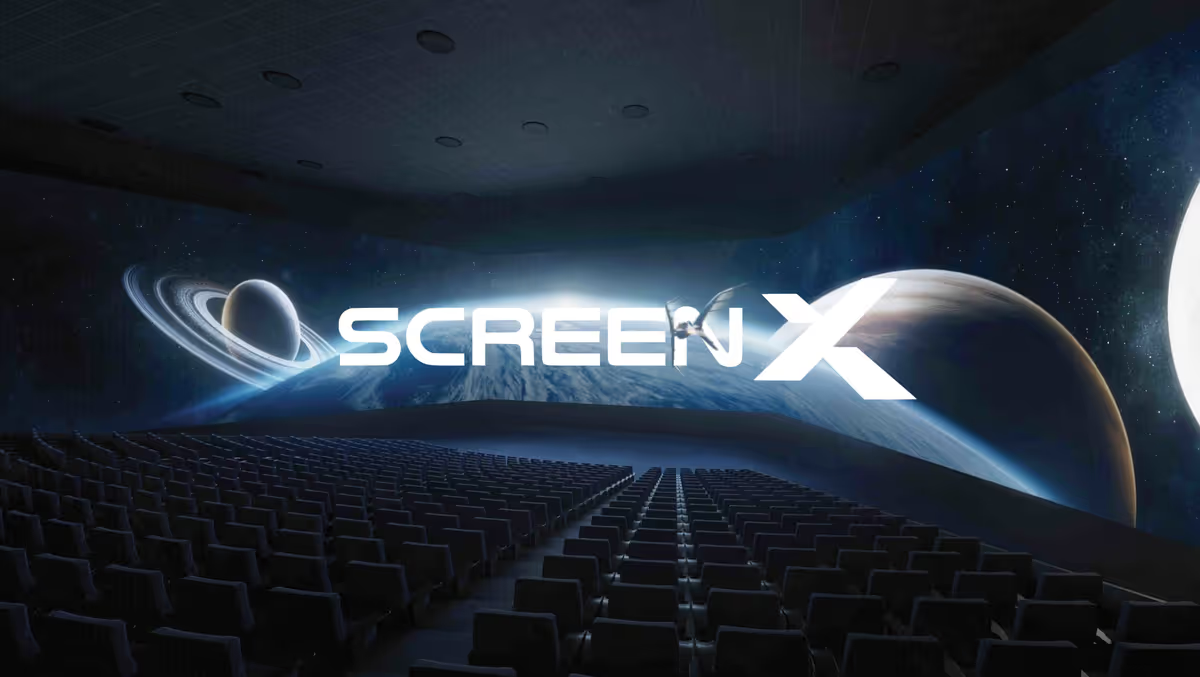
Put plainly: ScreenX theaters expand the film's visuals across three walls, making a 270-degree panoramic view. CJ's system accomplishes this by using multiple projectors across three walls, not just one like in a typical theater.
Watch the full film shared by SM Cinema after the jump:
ScreenX video demo. ©SM Supermalls / SM Cinema
In theory, ScreenX makes for a more immersive experience. But mileage does vary per patron and per film. Some will find themselves engrossed with the panoramic projection—this has been the case for triple-A gaming with hyper-wide monitors—and the rest will find the whole affair nauseating. What's more, not all films being screened for ScreenX are fully optimized for the format, which renders the side projections into these 2001: A Space Oddysey-like streaks that (to me, anyway) looks like the smudge tool in Photoshop.
You'll want to check if the film you're watching was specifically formatted for ScreenX. I mentioned Project Hail Mary earlier, and its filmmakers—Phil Lord and Christopher Miller—confirmed that the film is ScreenX-formatted. It's best to confirm if the film is ScreenX-ready.
Does ScreenX use Dolby Atmos?
The short answer is no. CJ claims that ScreenX theaters feature enhanced surround sound systems designed to compliment their unique panoramic projection, but globally, the most common audio system in use is Dolby 7.1 surround sound.
Luckily for us in the Philippines, the ScreenX theater in SM Mall of Asia features a Dolby Atmos sound system that pairs really well with immersive visuals. For a full list of Dolby Atmos theaters in the Philippines, check out our list below.
 Armando Dela Cruz
Full list of ScreenX theaters in the Philippines
There is currently only one theater in the Philippines equipped to screen ScreenX films, and that is the one in SM Mall of Asia.
SM Mall of Asia — L2 Entertainment Mall
Seaside Blvd, J.W. Diokno Blvd, Pasay City, 1300
(02) 8470 2222
You can book your tickets through the SM Cinema website.
How much is a ScreenX ticket?
As of writing, the cost of a ScreenX ticket in the Philippines is around PHP 700, notably only PHP200-ish less expensive than an IMAX ticket.
This ticket also includes a complimentary snack bundle redeemable at the SnackTime concession stand. Tickets can be booked in person or online with a PHP15 processing fee charged on top of the ticket price.
ScreenX or IMAX? Which format is better?
Both ScreenX and IMAX are premium film formats that can enhance your moviegoing experience. But to ensure you're getting your money's worth, let's dive a bit deeper into which format is better.
ScreenX widens the visuals of the film, effectively making its aspect ratio akin to wide anamorphoscopes. But conversions are very few and far between, and that's because the format demands the film being shown be specifically engineered for it. Meaning, unlike IMAX, you can't count on a ScreenX re-release of Kubrick's The Shining or Spielberg's Jurassic Park, for example. ScreenX seems great for pure spectacle films, where peripheral expansion can genuinely be a thrilling addition to the experience.
IMAX is a widely beloved, large-picture format. It's achieved by running 70mm film horizontally through the camera, resulting in a negative that's roughly 10x larger. Many filmmakers embrace IMAX's taller aspect ratio and higher resolution, including Denis Villenueve, Christopher Nolan, and Kathryn Bigelow. But my favorite use of IMAX recently comes from Jordan Peele's Nope, which used 65mm film in the format. For immersion and scale, IMAX simply has greater artistic fidelity in that it shows more of what the filmmakers capture and ensures that the viewers see that vision in its totality and not (literally) relegated to the viewers' peripheries.
Is ScreenX worth it?
The novelty of watching a film in panoramic format is a valid reason. By all means, swipe your card. But know what you're buying into. Ensure that the film you're watching is optimized for ScreenX to get your money's worth.